Thursday, 19 September 2013

Fukushima: what the government should be doing.

Getting the nuclear plant stable so it is not emitting or dumping nuclear waste is obviously an imperative.  The New Scientists assurances that it is less radioactive than Pacific nuclear tests such at Bikini Atoll, (which incidentally included the  irradiation of the Japanese fishing boat the (un)Lucky Dragon) are  not consoling.  Poison in the Well's  assessment of the evolution of nuclear waste policy in  helps build historical context,  but knowing that nuclear dumping has happened in other places is no consolation to the fishermen who can't sell their fish or to the farmers whose rice is growing in contaminated soil.  It's not acceptable anymore to be dumping waste into the ocean, irrespective of whether it can be feasibly argued to be safe.  Public outrage and distrust of information sources is too high. At the moment saying a bit of nuclear in your food is not ideal but on balance it's OK is a bit like saying be like trying to mount a case that a little bit of pedophilia is OK..

Anyway, the government doesn't seem to get the fact that they have to deal with the outrage as well as the nuclear problem, and that the two are inextricably linked.

At the moment Japan is considering taking Korea to the WTO to demand that they lift trade bans on fish caught in the waters off north eastern Japan.  In a sense it makes no sense to ban fish based  on location since fish can obviously swim... but the government misses the point that forcing people to buy fish which they believe is unsafe does not restore faith in the food system.  If anything it stigmatises all Japanese fish...

According to Sandman there are 5 steps that need to be taken to reduce outrage.  The government is not doing so well.
  • Admit the error.
I am trying to think of examples of the government admitting error. What comes to mind is PM Abe blaming former PM Kan for his handling of the situation in the initial days.  (I think history is likely to treat Kan well - it is bad, but it could have been much worse in the initial days.)  TEPCO has been admitting errors, but they have a tendency to do so only AFTER they have been caught in the spotlight.  
Abe's assertion that everything is under control might be good for getting an Olympics, but good at all for restoring the faith of those who are affected.

PM Abe's decision today that reactors 5 and 6 need to be decommissioned is long over due and very welcome.  It's not an admission of error, perse but it comes close.  The PM is planning to visit Dai-ichi this week... I hope  he spends enough time with people there to be more compassionate in the way the govt. deals with them.

  • Apologize 
Again, I can't think of any government apologies. TEPCO officials were apologizing to fisherman  the other day for dumping wastes that destroys the fishermen's livelihood. Apologies are often "kuchi dake" - just words in Japan (like anywhere I guess.)  Their website has emblazoned across it
We deeply apologize to the people of Fukushima and broader society for the tremendous inconvenience and anxiety caused by the accident at Fukushima Daiichi Nuclear Power Station.

"Inconvenience and anxiety"  !!  Abysmal EQ.  

Apologies are important, but need to reflect an understanding of the devastation that their actions have caused. if they trivialize, like the above... it just makes people angry and cynical.

  • Compensate and mitigate
Compensation is inadequate, and will never be adequate for the upheaval that people have faced.  But, farmers should not be farming land that they believe is unsafe.  If land is contaminated, people must be given the option to relocate.  It's hard to restore confidence when farmers themselves believe they are producing tainted goods.

It is a great pity for Fukushima prefecture that the area is so large and that the reactors were named after the prefecture.  All Fukushima produce is tainted by association.

The government has been doing a lot of health checks to alleviate concerns, except they haven't alleviated concerns because they have been finding an abnormal number of growths in children.  Medical experts are saying that it is too early for growths from the reactor to be showing up, and they are finding growths because they are testing.  (The inference being that if mass testings were done anywhere, elevated results would be found).   People have to wait and see.... which contributes to anxiety. 

  • Promise to never do it again
They can't and they won't.  So long as they can't and they won't they need to be doing testing has to be vigilant, and results have to be transparent.  Abe is still determined to bring nuclear back. Without cheap(ish) electricity, it's hard for Japan to regain exports.
  • Do penance
No evidence of that ...


Conclusion:

The situation is very difficult. It's easy to criticize the government and there is a lot they could have done and could be doing better - like insisting on safety procedures being followed, being transparent with information,consulting more with Chernobyl experts, communicating with the public and not treating the public as idiots by saying things like "everything is under control", being more empathetic and responsive to farmers and residents and making it clear that the health and well being of people in Fukushima prefecture is as important as people in Tokyo, making sure that information is available in Japanese and other languages, that there are people who are informed who can answer technical questions in lay people's language.

I am sure many govt. and TEPCO workers are working as hard as they can. It doesn't help that the policy with workers in Japanese government and corporations are often deliberately kept generalist but not truly specialised in anything.  Many of them are clearly, despite good intentions, way out of their depth.

I don't see the plight of the farmers being resolved any time soon, nor is there much to persuade those who are anxious about food safety that it's Ok to consume food from the north.  I don't think the government has the PR skills, or the integrity to persuade people otherwise.

My outrage level is not nearly as high as my food consumption from Fukushima. A lot of the reaction is  hysterical, inconsistent and uninformed, people are very risk averse when they feel the govt. is playing them for mugs.  But the the lack of transparent information,  lack of effective communication, lack of empathy in listening to and acting on concerns makes it almost inevitable.

All of this compounded by media that in many cases is not interested in promoting deep understanding... While most of Japan can switch off or zone out or eat food from Kyushu,  for the farmers, fishermen and people of Fukushima - there is nowhere where they can avert their eyes.


Fukushima, radiation & data


This is an interesting graphic from http://xkcd.com/radiation/  It is the kind of information the government is working with - there is radiation, but it's not that dangerous. This kind of information, while extremely useful and reassuring,  by itself is totally inadequate for appeasing outrage.

Wednesday, 18 September 2013

The plight of Fukushima farmers part III


  • Individually controlled vs. controlled by others
Farmers have very limited control. They are told where they can farm, where they can't farm. They are told what is "safe" and what is "not safe".  Despite misgivings about tilling the soil on land with radioactive readings, they are told that it's not contaminated enough for them to be compensated to the extent that allows them to move somewhere else or acquire new skills to pursue a different career. They go to meetings - like the one on the video- and the people who do control the decisions don't understand that part of the core anxiety of farmers is that the they have been rendered totally impotent in  decision making. 
  • Fair vs. unfair
Not fair.  Not fair. Not fair at all.  Even thought some of the places near the plant - in particular Tomioka - (but not Namie which has a long history of resistance against the plant) received financial incentives to have the plant in their local government area. This was compensation (bribes) for the plant; it wasn't to mollify people, who had been sold the myth of "Atoms for Peace", in the face of nuclear meltdown.   Anywhere in the world agriculture and fishing have an uneasy relationship with mining and heavy industry.  The integrity of agricultural products depends on perceptions of food safety.  For farmers who have been campaigning against the plant for years, it's bitterly unfair.  Rural Japan provides the oxygen for the cities to live.  It's an unfashionable point of view that is also found in the sentimentalized fascist constructions of a mythological glorious past.  But in reality Tokyo in particular relies on the regions for domestically produced energy - in the case of Tokyo, much of it from Tohoku. Nuclear plants in particular have kept energy cheap, at least cheaper than it would have been, and allowed Japanese industry to thrive.  The constant stream of cheap labour from the north facilitated the post war reconstruction.  Hiro's uncles were typical of their generation - rice farming in the spring summer and autumn in Akita,  labourers in Tokyo through the summer.  The children of the sixties and seventies left the regions for education, many finding work in Tokyo and making it their home.  The farming towns of Fukushima, like the farming towns all over Japan, have dwindling and aging populations.   There is outrage in Tokyo about potential danger to "our" food, but you see hints of outrage against farmers too for being complicit in knowingly producing food that is contaminated.  
The unfairness of that perspective, is something I lack words to describe.

  • Morally irrelevant vs. morally relevant
As Peter Sandman says, pollution "used to be unimportant (but) now pollution is morally wrong and polluters are reprehensible." We can subsitute "nuclear residue". It used to be unimportant, because it wasn't an issue, but now radioactive residue is absolutely unacceptable.  It makes absolutely no difference whether the Maximum Residue Level is 10 becquerels or 100,000 becquerels.  The fact is any becquerels is unacceptable. Mass opinion, in the absence of scientific "proof" does not want any becquerels as residue in their food.  The fact mass opinion doesn't condemn clogging tonkatsu or transfat filled Oreos, permits smoky coffee shops and doesn't question the intentional irradiation of food as a hygiene method  are a point of irony that bemuse me, but essentially not relevant to the fact that in the popular mind there is no safe level of nuclear residue.  No amount of persuading that 100 becquerels is safe, will convince the population that nuclear residue is comparable  to something like butter  where some is OK, but too much is bad for your health....

  • Responsive process vs. unresponsive process
The government has done some.... they've made an exclusion zone.  But the farmers that are complaining here are not being listened to.  The govt. and TEPCO are not being open and transparent about how decisions are being made.They are  not admitting that they have and are making mistakes.  TEPCO is not admitting mistakes.  It was announced perhaps two weeks ago that no-one is going to be prosecuted for the mistakes made.  Despite the fact that warnings were ignored, false information was given, no-one is going to be held accountable.  Listening to farmers talking about their dire situation and responding with what may as well be  - you are gullible for believing rumours that your food is not safe is not the kind of response that heightens anger, outrage and mistrust.

  • Trustworthy sources vs. untrustworthy sources
The government and TEPCO have lost all credibility.  PM announcing that the situation is under control to the IOC sent shockwaves through much of Japan.... For the farmers in this video, they are very clear that it's not under control.  They know themselves that they are contributing to a food chain that people can't trust.  If it's under control why is water with radiation being poured into the Pacific?  An official from the plant is on the record last week saying it's not under control.      If there are lies about such basic things, why would you believe in the integrity of the food chain, or that 100 becquerels is safe, or that it's not going to cause cancers, or it's not ever going to affect Tokyo...

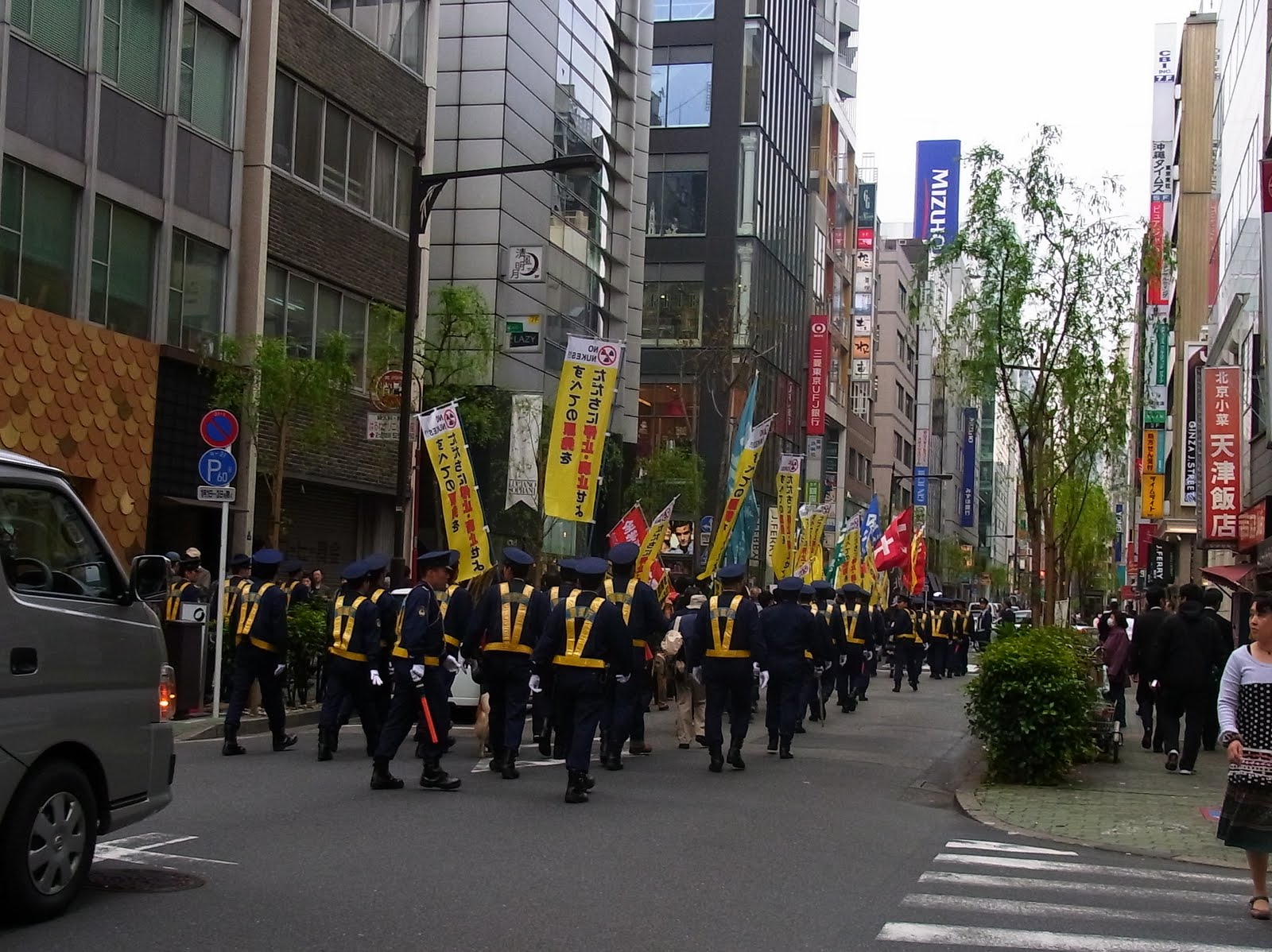
Anti Nuclear Protest - more undercover police than protesters

Uniformed police waiting for a protest of about 80 anti nuclear protesters


If the authorities put as much energy into responding to
people who live in affected areas as they spend intimidating
anti nuclear protesters... a lot more might be achieved.

The plight of Fukushima farmers part II


Continuing through Peter Sandman's list of factors contributing to outrage and applying it to Fukushima.   5-7

  • Not dreaded vs. dreaded
Nuclear accident - no explanation required.  In the tradition of Godzilla, On the Beach, The Day After... nuclear contamination is dreaded and stigmatised. 
  • Chronic vs. catastrophic
It started at a  catastrophe or near catastrophe, has arguably become chronic but the threat of a catastrophe lingers in the background.  Now that the feeling of impending doom has passed for the people of Tokyo it has become easier to ignore; the outrage here has diminished, somewhat. We can always buy produce from Kyushu...  But for people in Fukushima it's hasn't really moved from catastrophe to chronic and their representatives are charged with the task of persuading the authorities to recognize that it is a catastrophe.
  • Knowable vs. unknowable
This is on of the most basic problems.  What is safe? Who knows... The Ministries give assurances that they are complying with international acceptable radiation levels, and it is true that their levels are stricter than international averages: science is on their side, or so they say. And yet any minimum residue level is just a guess, usually a conservative guess, but there is no guarantee that there is no risk.  The public wants no risk; scientists want acceptable risk.   But acceptable to whom?

When you look at a tomato in Fukushima, or a rice field... it's not possible to know what level of radiation it has unless its tested.  And you can't test every tomato or every spec of soil in a rice field.  When you see Fukushima cucumbers in the shop, you have no idea whether it's from next to the exlusion zone or towns more than 70km away.  (Pointing out that many of these people probably allow their children to ride a bike without a helmet or eat beef with hormone growth promotants is a bit of a red herring and not relevant to the farmers in question.    Many people avoid Fukushima produce because they just don't know...and to a large extent it's understandable.


      Monday, 16 September 2013

      The plight of Fukushima's farmers.


      This 12 minute video of Fukushima prefecture farmers at a meeting with Ministry officials. It's really grim watching. Farmers are bringing very reasonable concerns about contaminated land, contaminated food, the precarious existence of those who want to evacuate but can't.  The Ministry officials are sincere, within their capabilities, and are troubled by the plight of the farmers, but there is a total failure in communication. The farmers believe their food and land is contaminated, the Ministry sees fears of radiation being the product of "terrible rumours".   
      The farmers will walk away from the meeting frustrated, angry and feeling that they have not been listened to. It's the Ministry's job to listen and respond to what they hear, not just the words but the feelings.  They don't  don't know this and I assume they don't know how to do this. Telling a farmer that people in the Ministry buy rice from Fukushima does nothing to make a farmer who believes he is selling contaminated rice think that the rice is now safe

      Peter Sandman, a pioneer of a risk communication emphasises that where the public doesn't understand the risk, educating the public is useful.  In contrast, where there is public outrage,  public education of risk is not enough, the outrage itself must be dealt with.
      http://www.psandman.com/articles/risk.htm

      Looking down Sandman's twelve point list of factors that contibute to outrage, it's hard to see any kind of resolution to the situation in Fukushima  short of making it financially possible for anyone who wants to evacuate to do including giving people the means to re-establish livelihoods. The situation on the left hand side reduces outrage; the situation on the right exacerbates it.
      • Voluntary vs. coerced 
      There is nothing about Fukushima that is voluntary. The exclusion zone has been set. For those outside the exclusion zone, there is no assistance to re-locate or re-establish themselves. Farming itself is co-erced.  Farmers don't want to produce goods with radiation, even if it is below the 100 bequerels that has been established as safe, but if they don't produce, they have no income.
      • Natural vs. industrial
      There is nothing about Fukushima that is natural. Radiation may be a naturally occurring substance, but it's not in Fukushima. The tsunami may have been the catalyst but it was industrial and government failures that lead to the failure at the nuclear plants.
      • Familiar vs. not familiar
      Japan spent the 50s - 2011s making nuclear palatable. For a country that experienced nuclear attacks, the concerted effort of government, media and industry, not to mention the seduction of cheap energy prices, anti-damming ecology movments, fears of global warming made remarkable inroads into making nuclear a  popularly acceptable energy alternative.  And yet, the stigma of nuclear pollution and the health of those who were irradiated at Hiroshima and Nagasaki remain in the public psyche.  The familiarity of Hiroshima and Nagasaki combined with the unfamiliarity of knowing how constant low level radiation affects people combine to elevate anxiety.
      • Not memorable vs. memorable
      Memorable... 3 years ago you'd be hard pressed to find someone outside of Japan who knew where Fukushima was. Now you'd be hard pressed to find someone with media access who did not.  The stigma of Fukushima is palpable. In one of my classes a student presented on her hometown.  She said she'd lived there for two years. In Q & A time one of her classmates asked where she lived before that. She replied Fukishima and that she was a post-disaster evacuee.  The unease was palpable. There was no unkindness, more like an OMG....Fukushima...  It's a tainted word, anywhere, the new Chernobyl.
      • 5-12 to come tomorrow.

      Friday, 7 December 2012

      Another quake


      Another quake in a very similar location. At 7.3M it's a lot smaller, but things still shook a lot here.  A tsunami warning has been issued. May it turn out to be minor and that there are enough blankets on hand to keep people warm.  It's a very cold night, but thankfully no rain or snow.


      Tuesday, 31 July 2012

      Electricity and politics - summer 2012 (p4)

      Much more than last year,  this year is being characterised by systematically organised protests. 
      Last week and the week before I went to the protests at Kokkai Gijidou Mae - outside the Prime Minister's official residence. I was there more to see what was happening rather than to protest. I can't say I'm unequivocally in the anti nuclear camp, though obviously the current situation in Fukushima is completely  unacceptable.

      Anti nuclear power protests have a long history in Japan, particularly with the legacy of Hiroshima and Nagasaki.  Government efforts to subdue the protests has an equally long history.  (see this article by Daniel Aldrich for an insight into the way the government has operated to get nuclear established.)  In some ways the protests are about much more than nuclear, they seem to be about democratic fundamentals.  Having said that though, I am not sure how widespread the sentiments are; I have heard few reports of protests in other areas.  It will be interesting to see the next election.


      Our destination was the corner diagonally opposite.
      But crossing the road was banned. It was 4pm, the  protests were
      at 6 pm.  I was there with 2 friends who were visiting, and two
      of their Japanese friends.  To reach our destination we had to walk
      the four sides of the Diet building - more than 1km I guess.
      The same people being turned away.  We were on the same side
      of the road as the PM house, about 70 m. from where we were.
      Plenty of police - who were all very polite, but the numbers
      are intimidating.
      We were at the corner diagonally opposite the police when we were told to go back.
       
      Protestors were told strictly by organizers that any speeches must only relate
      to the anti nuclear agenda.  A key strategy of successful protesting
       - keeping a clear target.
      This guy holding a post that I can't explain and neither could the people
      near me whom I asked. He was bending the rules by shuffling back and forth in
      the pedestrian corridor.  The police tolerated him for a while, but then asked him to
      step inside the protesters area. It took the summoning of an obviously older and
      more senior police officer to persuade him.
      I have yet to see anyone actively defy the police.
      Inside Kokkai gijidou mae station - not enough room to get out.
      Protestors "we don't need nuclear power"
       
      The Diet building in the background with police and baricades between it
      and the people.... symbolic really when you consider that there has been
      negligible attention been paid by politicians.
      Protests of 27th - the road by the PM's residence (on the other side)
      is blocked to traffic.
      Graffiti on a post box - "Fuck Nuclear Power".  Intersetingly written on
      what looks like a beginners English name tage.
      The Post box
      I met up with a friend and fellow blogger
      Rurousha to go on the 27th July 2012 protests. We met in
      Hibiya Park, which is often a site for protests, though the size is too small
      to have large rallies.
      A marshalling point for participants?  Just near the Ministry of Industry  (METI) building,
      between Hibiya Park and the Diet, a group of protestsers had set up shop.
      Protests outside METI.

      Police keep protestors on a very light leash. Protesters can't move
      out of the "protesters area". One side of the foot path is shut off
      to enable people to walk along the footpath, but since there is almost
      no pedestrian traffic, it serves a double bonus purpose as
      preventing protesters from congregating in a more condensed area.

      For Rurousha's account with an African perspective, see
      http://rurousha.blogspot.jp/2012/07/nuclear-protesters-you-have-to-learn.html

      Fukushima veges back in the local shops

      For the first time in months I've seen Fukushima veges in a supermarket near us.In Akihabara there has been a dedicated Fukushima shop with Fukushima veges, but most regular shops err on the side of caution when it comes to perceptions of consumer safety and opt not to stock food stuff sourced from Fukushima.  (The food service industry is a totally different situation; no requirements on labelling the origin of foods mean  particularly at the cheap end of the spectrum, there is strong incentive just to source what is cheapest.)

      It's been very tough on farmers in the area. One of Hiro's uncles is involved in fruit and vegetables in Ibaraki. At New Year when they came to Akita they were talking about the irony of "Ganbarou Tohoku" when so many former customers wouldn't touch food from Ibaraki, let alone Fukushima (though some parts of Ibaraki are closer to the plant than some parts of Fukushima.)    The graph below shows the lack of accuracy in categorizing food by political boundaries -  prefectures isn't an accurate way to avoid food from areas that have high levels of cesium.


      MEXT via the Japan Times
      Cesium readings Sept 2011.

      Though the colouring used looks  dubious if you refer to this website

      http://allegedlyapparent.wordpress.com/2012/03/06/comparison-japan-mext-fallout-map-cs-137-in-unep-colors-higher-resolution/, but on the other hand the difference in the scale of the map  distorts the picture as well.  

      Yesterday we biked to Ibaraki and talked to the same uncle.  He said things are much better there now. He was showing us the piles of documents that certified products as cesium free, and he was saying things have recovered for them now - people are buying Ibaraki products again.  I didn't get a chance to ask him about how the testing is conducted, where and by whom, but it was obviously a great relief to him that they were testing cesium free. (They were testing cesium free from the outset, but it took some time for customers to return.)

      The testing will continue for years, as much for gathering data generally to interpret nuclear accident as it is for protecting consumers.  Norway is still having problem with animals over the maximum allowable level of 
      http://theforeigner.no/pages/news/chernobyl-still-affects-norway/   Incidentally, I read recently that the Scandanavian cesium limits are 5 times higher than Japan.

      People have to make their own decisions about what to eat and what not to, but I was glad to see the tomato and cucumber and bought a packet of each.

      A sign in Ikebukuro advertising the fukushima
      market in Akihabara.
      Cucumber from Fukushima - the precture name is written on
      the second line down in small letters.
        
      Cucumbers and tomato from Fukushima.

      Electricity & politics Summer 2012 - (3)

      Last year to counter the sudden loss of energy generation capacity drastic measures were taken to reduce electricity consumption, The neon of Tokyo was dimmed; the trains operated on reduced schedules; excess aircon was turned off & temperatures raised;  universities shut early for the summer (in some cases without paying the teachers...). Even though in some ways the effort last year was token, efforts to be sparing with electricity were much more conspicuous, and the situation in Fukushima in someway seemed closer to people. For a flashback to last year 
      This year public displays of solidarity with energy saving seem less apparent and  I am sceptical about the extent it remains in people's consciousness, though that may change with electricity hikes at the beginning of September. Today Seibu in Ikebukuro, which has two sets of doors to enter to cut the loss of cool air, had both sets wide open - cold air going straight to the street... I closed them ;).  A couple of weeks ago I walked into a classroom where there the power to adjust the thermostat has not yet been appropriated by the administration.  It was set to a frigid 19 degrees - the lowest it would go....   For homework they always do a piece of writing - I asked them to write about electricity savings.  Their answers were intriguing.  Out of 70 students, not one student suggested ceasing to use aircon  period, though some thought they could reduce the use.  Most answers were in the "causing me no inconvenience" category.

      Answers included go to public place during the day time that have aircon so you don't have to pay for aircon at home..., turn the temperature of the aircon up (standard govt. line), turning off the TV, unplugging appliances not being used, a few talked of green curtains, a lot talked of developing alternative energy sources - that part was encouraging since that is their academic field.

      When you look at today's electricty consumption in the TEPCO distribution area compared with last year's for the same day it's not very encouraging.  Admittedly it was about 5-6 degrees hotter today than this day last year. I am not sure what is accounting for the difference in electricity usage - as far as I know this year heavy industry is not being put on rotation for energy usage.  I haven't seen any analysis to account for the difference.

      One crucial aspect to changing electricity consumption is changing people's thinking, for the generation brought up in aircon, this will be no easy task.

      Daily usage & predicted usage - http://www.tepco.co.jp/en/forecast/html/index-e.html

      Electricity & Politics summer 2012 (2)


      On Monday 16, Marine Day, a public holiday - unless you work in  some higher education institutions or the retail sector - anti nuclear protesters organised a major rally in Yoyogi Park.  I got there for the tail end of it. I had classes until 2.30 and had planned to go after that, but I'd left my hat at home and would burn to a crisp faster than you can say nuclear reactor...so delayed getting there until almost 4.The pictures are from the footbridges - it was very windy & I was doing my utmost not to have the ipad blow off...

      Saikadou hantai - we oppose the restart, Genpatsu iranai - We don't need nuclear power.


      The anti nuclear protesters march out of Yoyogi down Omotesando
      with the park & stadium in the background
      Marching down Omotesando. Protesters are kept to the far left
      to disturb traffic as minimally as possible.
      It was hot day, not for the faint hearted.
      There are often breaks in the marchers - the reason for it is that
      police hold marchers back at the traffic lights which is good for
      traffic flow but not so good for unity of the march.
      There is no civil disobedience in the marching - everything is
      very orderly, in total compliance with the law & the wishes of the
      police - even when the requests seem intentionally obtuse.
      Just as well Tokyo has no real crime...
      The very last of  the protesters march down Omotesando
      The police giving orders.
      Police keep protesters on a very tight leash
      Lazy lazy journalism. Two journalists talking to two police on the
      footbridge betwen the stadium and the station. The police had out
      their notebooks and the journalists copied it down verbatim.
      According to one of my professors at Sophia, it is customary
      for police to feed news stories to the media, particularly ones
      with salacious or gory details. A win win situation - police get their
      version of events out, the journos don't have to do any work...
      win win unless you factor in the public and democratic principles.
      I had dinner with a friend  the other day who occasionally mixes
      with serious bigwigs in Japan, and he summed it up well: "at the top
      they're all drinking buddies."
      ..

      Energy & politics summer 2012 (1)

      Things seems to be changing in Japan.  Though I can't really say in what direction.

      On Friday I went to the anti nuclear protests outside the prime ministers official residence - more to see what is happening rather than to be an active participant.   I have mixed feelings about nuclear issue.  On the one hand it has given Japan some stability particularly in the post oil shock era of energy uncertainty, but on the other hand the industry has been built on collusion and corruption.  It's partly paternalistic - that they that be know best,  but there has also been  very cynical manipulation and disregard for the population.  World over a lot of people believed in nuclear as a safe clean energy - presumably mostly in good faith.  However, a report commissioned by the Diet and released recently has stated plainly that the disaster was man-made - both the government and the regulators knew that TEPCO was stalling on making safety improvments that had been demanded.

      Japan survived for several months with no nuclear reactors operating - even though they had been supplying 30% of national energy. The week before last, the Oi plant in Fukui was brought back online, to meet the "serious shortfall" of industry, despite a reaosnable amount of opposition.   Opposition has been fuelled by claims that there is a fault line under the reactor.  The rationale for the restart doesn't seem to make complete sense.
      If the summer energy consumption is so much higher, it seems a no brainer to reduce the summer consumption.  And to be fair there are efforts being made, particularly at the government level.  The remedies being offered however tend to be increase the temperature of the aircon - the campaigns are not to turn off the aircon.  There are still restaurants and coffee shops that feel cold not cool, at uni I've walked into classrooms with the aircon on, the door open and no-one in the room...   In our building there were people adding a second aircon, which of course is their right, but I wonder how deeply the idea of electricity saving is seeping in to the public habits. Awareness of the need for electricity savings is there, but I'm sceptical about the degree of personal commitment to energy savings - particularly when someone else is paying the bill...
      The argument is always being put that without nuclear there can't be viable industry, but I'm yet to be convinced.  Industry seems to have been able to operate without the nuclear facilities.Japan has been built on a presumption of cheap electricity - poorly insulated houses, flippant electricity usage like toilet seat warmers (not such big energy consumers when the seat is left down, but it often doesn't seem to be the case), shops that have been set to 20 degrees, shops with out aircurtains.  Is it the availability of energy that has enabled the demand, or increased demand that has necessitated increased supply.  It has to be both.  There used to be promotional posters to switch over to all electric houses based on nuclear power being cheap.  I'll keep trying to dig some up.  


      Committment to setsuden: installing a second aircon...

      The graph below is quite interesting and perhaps turns on its head the idea that Japanese industry cannot survive without nuclear. 

      Japanese Energy Consumption
      http://www.tradingeconomics.com/japan/electric-power-consumption-kwh-wb-data.html


      Increased demand corrolates with increased supply - though establishing cause and effect is more difficult. 
      http://www.world-nuclear.org/info/inf79.html  scroll down for a list here of nuclear plants.

      Monday, 12 March 2012

      @AFP and post earthquake sensationalism of suicides


      TOKYO —
      The number of people who took their own lives in Japan drastically increased in the aftermath of last year’s huge tsunami and the nuclear disaster it triggered, the government says.  A more than 20% rise in the amount of suicides in one month was likely attributable at least in part to the widespread anxiety Japanese society felt in the aftermath of the catastrophe, an official said.
      In May last year 3,375 people killed themselves, more than 20% up on the same month a year earlier... (AFP)  http://www.japantoday.com/category/national/view/suicides-in-japan-spiked-after-march-11-disaster


      AFP (Agence France-Presse) has continued to propagate the myth that suicides in Japan have risen drastically as a result of the earthquake, syndicating stories that are at best gross distortions.  It might make for dramatic headlines, but it is minimizing the resilience of the people in the most affected areas,  it's demoralizing for the people who are working hard to reduce Japan's suicide rate, and trivializes the complex reasons behind suicide in Japan.

      There was  a spike in suicides in May following the earthquake but data released by the Cabinet Office last week shows that was an aberration for the year and overall there was a 3.3% decrease in suicide numbers nationwide.  This decrease also listed Miyagi and Iwate as among the top 5 prefectures to have had a decrease in numbers, Fukushima, and every other prefecture in Tohoku also registered a decrease. 

      The actual figures are here.


        Heisei 23 (red line) = 2011
        Heisei 22 (green line) = 2010
        Heisei 21( blue line) = 2009
        Heisei 20 (pale blue-green line) = 2008

      Or in table form

      For more detail and a prefectural breakdown see
      http://www8.cao.go.jp/jisatsutaisaku/toukei/pdf/siryou/gaikyou.pdf


      Thursday, 2 February 2012

      Radical globalization

      This is quite radical. I haven't heard of a Japanese company sending people to Asian countries in such numbers. It's very positive. No time for analysis at the moment.


      Aeon to post 1,000 new graduates to stores in China, Southeast Asia
      BUSINESS FEB. 03, 2012 - 07:03AM JST ( 0 )
      TOKYO —
      Retailer Aeon plans to post 1,000 newly hired graduates to stores in China and Southeast Asia as part of its expansion into those markets.
      Aeon executives told a news conference in Tokyo this week that the company plans to hire 3,000 staff in Japan and abroad for fiscal 2012.
      Aeon already has more than 100 supermarkets in China, Malaysia and Thailand, while Ministop Co, the company’s convenience store chain, operates in South Korea. Aeon said it plans to open stores in Cambodia, Laos and Indonesia.
      The retailer said that it wants to give its young Japanese employees the experience of working overseas at the start of their careers.
      Japan Today