Tuesday, 17 May 2011

Japan the technology country 1 - photos


It's a cliched to talk about Japan being both super high tech and super traditional - nonetheless it's true.... Below are a few photos that I've dug up to show technology that has impressed me.  Blogger is not cooperating with formatting them well...

The almost completed first stage of
the Hokuriku Shinkansen at Itoigawa


Very high tech - the extensive Shinkansen
network throughout the country.

Old but still impresive hi tech
 Kanazawa snow melting
system on the road
Hi tech - Kanazawa station -
earthquake resistant curved
glass.


Hi Tech Travelator bridge to Harumi
Low tech - futons and washing hanging on
the balcony of Tokyo Metropolitan
Govt.  danchi in Kita-ku.

  
Fuji building Odaiba
High tech bubble economy architecture
De Beers building Ginza
Seriously high tech design


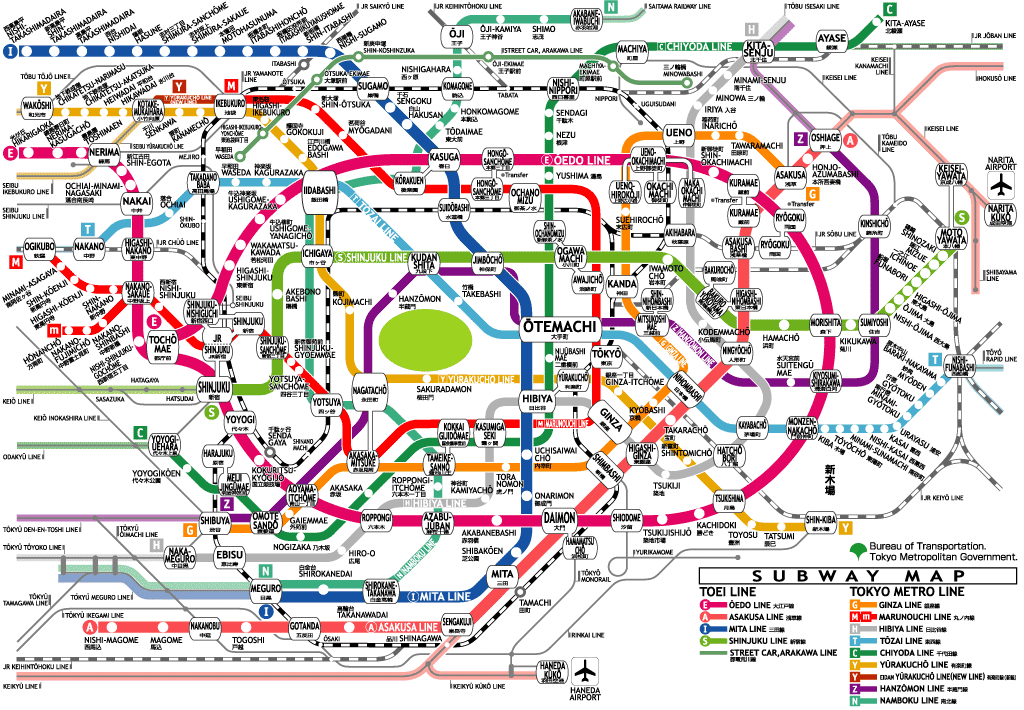
Smart money Suica cards

The very high tech super integrated
subway system of Central Tokyo


Fish drying in Chiba - 
very traditional
Mountain picked zenmai drying in Akita-
very traditional


Low tech innovation - portable tables
being constructed for hanami

Low tech innovation - milk cartons used
for writing waterproof notices in a park
in Kita-ku Tokyo.


Stacked car parking - high tech that's
taken for granted in Tokyo
Very high tech Nissan Leaf
prototype in Ginza


Thoughtfully high tech  -
convenient phone charging service
Yodobashi Okachimachi


Thoughtfully high tech - a lit up guide to
vacant toilets in JR Maihama station


Unnecessarily hi tech?
Eye recognition tobacco vending
machine..


Monday, 16 May 2011

Risk and Blame - Mary Douglas in the light of the Tohoku earthquake

Though an eccentric and quaint  meander through decades of grappling with the concept of risk and blame,  Douglas’ article connects closely to the post earthquake situation in Japan. 

Douglas begins with a reflection on a previous book – Purity and Danger – in which she sought to vindicate the thought processes of ‘primitives’, who attribute misfortune to spiritual beings – (in contrast to we ‘moderns’  see misfortune as having material causes.  It is curious terminology and perhaps reflects the thoughts of a closeted academic world of the 1960s  that retained elements of social Darwinism despite demise of the British Empire.  It’s not really clear that the divide between moderns and primitives is really so polarized.  Though it seems to be standard, though dated, anthropological terminology, dividing the world into two very different, though not necessarily opposing camps may be flawed.   Perhaps it is just a tool, or even a metaphor,  to identify contrasting perspectives that are extremes on a continuum, rather than an attempt to describe a genuine dichotomy.    I’m not sure that casting ‘us’ against the ‘primitives’  serves us that well in understanding the response to the current situation in Tohoku.  Among the ‘moderns’,  there are people attributing the devastation to divine retribution. We have heard Gov. Ishihara talking about how the situation is ‘divine punishiment’[i] [i]Paul Wilson from the Sea Shepherd – in many respects at opposite sides of the political spectrum  – has also implied the tsunami is the revenge of the gods. [ii]Without reading Purity and Danger itself, it is difficult to comment on her assertion that  “primitives” engage dangers politically on behalf of the constitution,  while “moderns” disengage danger from politics and  ideology, placing it in the realms of science

Douglas discusses the way that people explain misfortune, remarking that the anthropologist notices that there is a fixed repertoire of possible causes among which a plausible explanation is chosen.  [iii]  She asserts that the explanations can be divided into different camps, and communities tend to be divided along this basis.  The first, moralistic, blames the victim. The second attributes it to the work of  adversaries within while the third places the blame on external adversaries.      This three camps of blame approach seems to omit blaming of the self.  In the case of the tsunami, especially at Okawa primary school, where the students who survived were almost with exception the ones who had been picked up after school, I imagine there would be much blaming of the self among parents who did not pick up their children.

An additional type of community that Douglas explores is no fault communities – communities which do not attribute blame, surviving by a ‘heroic programme of reconciliation.’  Douglas spends time discussing her initial doubts, hoping the reader is persuaded by the fact that she was persuaded rather than by the evidence that might have persuaded her.  The idea of dividing communities along this basis seems simplistic as it fails to account for different kinds of events and the circumstances in which they occur.  

Douglas asserts that real blame has become guaranteed by its objective basis in knowledge.[iv]  While I take her point that where there is ‘objective knowledge’, it maybe easier to ascertain whether a situation was preventable.   And the perception of whether a situation was preventable is undoubtedly a determining factor in the degree of blame felt.    However the same knowledge doesn’t guarantee the same perception, as  Douglas herself would agree.   In Fukushima there is a contrasting case of Tomioka and Namie towns. Tomioka as a whole supported TEPCO’s  nuclear plant – it brought jobs and a degree of prosperity.  Namie however has a long history of opposing the nuclear plant.  Will the anger in Namie and the wish to blame TEPCO be greater – I haven’t read anything about it, nor have I been there.  But intuitively I would say without doubt.  A long history of opposition to TEPCO is likely  to manifest itself in blame.  If this is contrasted with the Sanriku, where towns were built within defined tsunami inundation zones, circumstances rather than preexisting attitudes to misfortune are likely to shape attitudes.

Douglas attributes differences to institutional differences – a subject that she says needs further study. Though I have no research to support it, I posit that circumstances would also influence differences in attitudes. 

The most interesting aspect of Douglas’ research is, her advocacy of forgiveness based no blame society, undoubtedly influenced by her religious background.  She makes the point that no fault options which are generous to the victims are actually cheaper than litigation.  To a large extent I share her idealism; in theory I agree that there is little to be gained by blame; blame is cancerous to the spirit.  The past cannot be changed and embittering oneself with ‘what might have beens’ brings little comfort to those who are mourning or aggrieved.  For the people who have lost loved ones and livelihoods in the tsunami, blaming the local governments for lack of tsunami walls, or blaming themselves for living where they did, or not going to collect a child from a school that was washed out, is not going to undo the tragedy. Blame can be particularly unhelpful where assessment is made without the facts. A Japan Probe article published shortly after the tsunami condemned the local government in Otsuchi for its lack of decision making accusing it of being culpable in the deaths of its citizens.[v]  A visit to Otsuchi reveals that much of the town lay well outside of designated inundation zones. The guardian newspaper writes that rather than sitting idly deciding what to do – they had established a  disaster headquarters in a place they thought was safe. [vi]

Although I sympathise with her position Douglas’ proposal that we ‘move out of both the adversarial patterns of blame allocation and the moralistic one, into the pattern where no one gets blamed at all’, doesn’t necessarily provide a solution where fault is unquestionably present, if there is no fault, no punishment is there sufficient deterrent to prevent reoccurrences, particularly in an industrial capitalist society?  Sherpa in Nepal, for the sake of community harmony, have much greater incentive to forgive and move on than people displaced from homes and livelihoods by industrial accidents.    The no blame approach neglects the deterrent effect of litigation.  In the case of TEPCO, if negligence is found to have occurred, and deaths related to the reactor are considered industrial manslaughter, might not gaol be appropriate,  to ensure greater responsibility in the future? Can a corporation in it’s entirety be blamed, and can a non human entity which exists only because of the profit motive, be forgiven?  A no blame society places a heavy burden on the aggrieved party.

Despite perceived her perception of advantage of a no fault culture is whether no blame conversely also means no thanks.  Recent news articles have been expressing thanks to the former mayor of Fudai who insisted on a 15m tsunami wall – the town was unscathed.[vii]

Douglas discusses the rise of the concern of risk in the context of Ernest Gellner’s analysis of moving into a global society. ‘Industrialization draws members of small local communities into larger regional, national and international spheres which require new concepts and loyalties to develop common discourse. Douglas adds that liberation from the small community also means losing the old protections. At the national level of operations, the nation has to provide new kinds of protection. In the current situation in Tohoku, while events are creating a national discourse, without the protection of the national community, and indeed the international community, the citizens of Tohoku would be afforded much less protection than had they been left to their devises of local community protection.   As Douglas says, the nation has to provide new kinds of protection[viii].  In the case of the Tohoku earthquake, it is happening.
Institutional differences in the culture of blame and constructive approaches for both reconciliation and justice are areas in which the Tohoku Earthquake can provide rich scope for study.


I opted to do Douglas’  Risk and Blame  rather than the Latour.  Both relate to the post earthquake situation in Japan, though given  unusual time constraints this week, I have not had sufficient time to produce anything on Latour I am prepared to “publish”.

Saturday, 14 May 2011

Aneyoshi & Tsunami warnings

Another article I would like to follow up.

Tsunami Warnings, Written in Stone

www.nytimes.com/2011/04/21/world/asia/21stones.html

Ko Sasaki for The New York Times
A stone tablet in Aneyoshi, Japan, warns residents not to build homes below it. Hundreds of these so-called tsunami stones, some more than six centuries old, dot the coast of Japan.


  • R

ANEYOSHI, Japan — The stone tablet has stood on this forested hillside since before they were born, but the villagers have faithfully obeyed the stark warning carved on its weathered face: “Do not build your homes below this point!”
Multimedia
Ko Sasaki for The New York Times
Tamishige Kimura, village leader of Aneyoshi, Japan, took a walk with his grandson this week.
    Residents say this injunction from their ancestors kept their tiny village of 11 households safely out of reach of the deadly tsunami last month that wiped out hundreds of miles of Japanese coast and rose to record heights near here. The waves stopped just 300 feet below the stone.
    “They knew the horrors of tsunamis, so they erected that stone to warn us,” said Tamishige Kimura, 64, the village leader of Aneyoshi.
    Hundreds of so-called tsunami stones, some more than six centuries old, dot the coast of Japan, silent testimony to the past destruction that these lethal waves have frequented upon this earthquake-prone nation. But modern Japan, confident that advanced technology and higher seawalls would protect vulnerable areas, came to forget or ignore these ancient warnings, dooming it to repeat bitter experiences when the recent tsunami struck.
    “The tsunami stones are warnings across generations, telling descendants to avoid the same suffering of their ancestors,” said Itoko Kitahara, a specialist in the history of natural disasters at Ritsumeikan University in Kyoto. “Some places heeded these lessons of the past, but many didn’t.”
    The flat stones, some as tall as 10 feet, are a common sight along Japan’s northeastern shore, which bore the brunt of the magnitude-9.0 earthquake and tsunami on March 11 that left almost 29,000 people dead or missing.
    While some are so old that the characters are worn away, most were erected about a century ago after two deadly tsunamis here, including one in 1896 that killed 22,000 people. Many carry simple warnings to drop everything and seek higher ground after a strong earthquake. Others provide grim reminders of the waves’ destructive force by listing past death tolls or marking mass graves.
    Some stones were swept away by last month’s tsunami, which scientists say was the largest to strike Japan since the Jogan earthquake in 869, whose waves left sand deposits miles inland.
    Aneyoshi’s tsunami stone is the only one that specifically tells where to build houses. But many of the region’s names also seem to indicate places safely out of the waves’ reach, like Nokoriya, or Valley of Survivors, and Namiwake, or Wave’s Edge, a spot three miles from the ocean that scholars say marks the farthest reach of a tsunami in 1611.
    Local scholars said only a handful of villages like Aneyoshi heeded these old warnings by keeping their houses safely on high ground. More commonly, the stones and other warnings were disregarded as coastal towns grew in the boom years after World War II. Even communities that had moved to high ground eventually relocated to the seaside to be nearer their boats and nets.
    “As time passes, people inevitably forget, until another tsunami comes that kills 10,000 more people,” said Fumio Yamashita, an amateur historian in Iwate Prefecture, where Aneyoshi is situated. He has written 10 books about tsunamis.
    Mr. Yamashita, 87, who survived the recent tsunami by clinging to a curtain after waters flooded the hospital where he was bedridden, said Japan had neglected to teach its tsunami lore in schools. He said the nation had put too much store instead in new tsunami walls and other modern concrete barriers, which the waves easily overwhelmed last month.
    Still, he and other local experts said that the stones and other old teachings did contribute to the overall awareness of tsunamis, as seen in the annual evacuation drills that many credit with keeping the death toll from rising even higher last month.
    In Aneyoshi, the tsunami stone states that “high dwellings ensure the peace and happiness of our descendants.” Mr. Kimura, the village leader, called the inscriptions “a rule from our ancestors, which no one in Aneyoshi dares break.”
    The four-foot-high stone stands beside the only road of the small village, which lies in a narrow, cedar-filled valley leading to the ocean. Downhill from the stone, a blue line has been newly painted on the road, marking the edge of the tsunami’s advance.

    ast week, a university group said the waves reached their greatest height in Aneyoshi: 127.6 feet, surpassing Japan’s previous record of 125.3 feet reached elsewhere in Iwate Prefecture by the 1896 tsunami.
    Multimedia


      Just below the painted line, the valley quickly turns into a scene of total destruction, with its walls shorn of trees and soil, leaving only naked rock. Nothing is left of the village’s small fishing harbor except the huge blocks of its shattered wave walls, which lie strewn across the small bay.
      Mr. Kimura, a fisherman who lost his boat in the tsunami, said the village first moved its dwellings uphill after the 1896 tsunami, which left only two survivors. Aneyoshi was repopulated and moved back to the shore a few years later, only to be devastated again by a tsunami in 1933 that left four survivors.
      After that, the village was moved uphill for good, and the stone was placed. Mr. Kimura said none of the 34 residents in the village today know who set up the stone, which they credit with saving the village once before, from a tsunami in 1960.
      “That tsunami stone was a way to warn descendants for the next 100 years that another tsunami will definitely come,” he said.
      For most Japanese today, the stones appear relics of a bygone era, whose language can often seem impenetrably archaic. However, some experts say the stones have inspired them to create new monuments that can serve as tsunami warnings, but are more suited to a visual era of Internet and television.
      One idea, put forth by a group of researchers, calls for preserving some of the buildings ruined by the recent tsunami to serve as permanent reminders of the waves’ destructive power, much as the skeletal Atomic Bomb Dome in Hiroshima warns against nuclear war.
      “We need a modern version of the tsunami stones,” said Masayuki Oishi, a geologist at the Iwate Prefectural Museum in Morioka.
      Despite Aneyoshi’s survival, the residents are in no mood for rejoicing. Four of the village’s residents died last month: a mother and her three small children who were swept away in their car in a neighboring town.
      The mother, Mihoko Aneishi, 36, had rushed to take her children out of school right after the earthquake. Then she made the fatal mistake of driving back through low-lying areas just as the tsunami hit.
      The village’s mostly older residents said they regretted not making more of an effort to teach younger residents such tsunami-survival basics as always to seek higher ground.
      “We are proud of following our ancestors,” the children’s grandfather, Isamu Aneishi, 69, said, “but our tsunami stone can’t save us from everything.”


      Fudai tsunami walls

      http://www.huffingtonpost.com/2011/05/13/fudai-japan-tsunami-_n_861534.html

      This is an article from the Huffington Post, written by Tomoko Hosaka talking about the success of the tsunami wall in Fudai, near Miyako.  I would like to follow the article up later on.


      How Fudai, Japan Defied The 

      Tsunami Devastation

      Fudai Japan
      TOMOKO A. HOSAKA   05/13/11 02:04 PM ET   AP

      FUDAI, Japan — In the rubble of Japan's northeast coast, one small village stands as tall as ever after the tsunami. No homes were swept away. In fact, they barely got wet.
      Fudai is the village that survived – thanks to a huge wall once deemed a mayor's expensive folly and now vindicated as the community's salvation.
      The 3,000 residents living between mountains behind a cove owe their lives to a late leader who saw the devastation of an earlier tsunami and made it the priority of his four-decade tenure to defend his people from the next one.
      His 51-foot (15.5-meter) floodgate between mountainsides took a dozen years to build and meant spending more than $30 million in today's dollars.
      "It cost a lot of money. But without it, Fudai would have disappeared," said seaweed fisherman Satoshi Kaneko, 55, whose business has been ruined but who is happy to have his family and home intact.
      The floodgate project was criticized as wasteful in the 1970s. But the gate and an equally high seawall behind the community's adjacent fishing port protected Fudai from the waves that obliterated so many other towns on March 11. Two months after the disaster, more than 25,000 are missing or dead.
      "However you look at it, the effectiveness of the floodgate and seawall was truly impressive," Fudai Mayor Hiroshi Fukawatari said.
      Towns to the north and south also braced against tsunamis with concrete seawalls, breakwaters and other protective structures. But none were as tall as Fudai's.
      The town of Taro believed it had the ultimate fort – a double-layered 33-foot-tall (10-meter-tall) seawall spanning 1.6 miles (2.5 kilometers) across a bay. It proved no match for the tsunami two months ago.
      In Fudai, the waves rose as high as 66 feet (20 meters), as water marks show on the floodgate's towers. So some ocean water did flow over but it caused minimal damage. The gate broke the tsunami's main thrust. And the community is lucky to have two mountainsides flanking the gate, offering a natural barrier.
      The man credited with saving Fudai is the late Kotaku Wamura, a 10-term mayor whose political reign began in the ashes of World War II and ended in 1987.
      Fudai, about 320 miles (510 kilometers) north of Tokyo, depends on the sea. Fishermen boast of the seaweed they harvest. A pretty, white-sand beach lures tourists every summer.
      But Wamura never forgot how quickly the sea could turn. Massive earthquake-triggered tsunamis flattened Japan's northeast coast in 1933 and 1896. In Fudai, the two disasters destroyed hundreds of homes and killed 439 people.
      "When I saw bodies being dug up from the piles of earth, I did not know what to say. I had no words," Wamura wrote of the 1933 tsunami in his book about Fudai, "A 40-Year Fight Against Poverty."
      He vowed it would never happen again.
      In 1967, the town erected a 51-foot (15.5-meter) seawall to shield homes behind the fishing port. But Wamura wasn't finished. He had a bigger project in mind for the cove up the road, where most of the community was located. That area needed a floodgate with panels that could be lifted to allow the Fudai River to empty into the cove and lowered to block tsunamis.
      He insisted the structure be as tall as the seawall.
      The village council initially balked.
      "They weren't necessarily against the idea of floodgates, just the size," said Yuzo Mifune, head of Fudai's resident services and an unofficial floodgate historian. "But Wamura somehow persuaded them that this was the only way to protect lives."
      Construction began in 1972 despite lingering concerns about its size as well as bitterness among landowners forced to sell land to the government.
      Even current Mayor Fukawatari, who helped oversee construction, had his doubts.
      "I did wonder whether we needed something this big," he said in an interview at his office.
      The concrete structure spanning 673 feet (205 meters) was completed in 1984. The total bill of 3.56 billion yen was split between the prefecture and central government, which financed public works as part of its postwar economic strategy.
      On March 11, after the 9.0 earthquake hit, workers remotely closed the floodgate's four main panels. Smaller panels on the sides jammed, and a firefighter had to rush down to shut them by hand.
      The tsunami battered the white beach in the cove, leaving debris and fallen trees. But behind the floodgate, the village is virtually untouched.
      Fudai Elementary School sits no more than a few minutes walk inland. It looks the same as it did on March 10. A group of boys recently ran laps around a baseball field that was clear of the junk piled up in other coastal neighborhoods.
      Their coach, Sachio Kamimukai, was born and raised in Fudai. He said he never thought much about the floodgate until the tsunami.
      "It was just always something that was there," said Kamimukai, 36. "But I'm very thankful now."
      The floodgate works for Fudai's layout, in a narrow valley, but it wouldn't necessarily be the solution for other places, Fukawatari said.
      Fudai's biggest casualty was its port, where the tsunami destroyed boats, equipment and warehouses. The village estimates losses of 3.8 billion yen ($47 million) to its fisheries industry.
      One resident remains missing. He made the unlucky decision to check on his boat after the earthquake.
      Wamura left office three years after the floodgate was completed. He died in 1997 at age 88. Since the tsunami, residents have been visiting his grave to pay respects.
      At his retirement, Wamura stood before village employees to bid farewell: "Even if you encounter opposition, have conviction and finish what you start. In the end, people will understand."
      ___
      Follow Tomoko A. Hosaka at http://twitter.com/tomokohosaka